Every data centre watches its power bill obsessively. Far fewer watch the water bill with the same discipline — yet water is fast becoming the metric that decides whether a new facility gets approved at all. The number at the centre of that conversation is water usage effectiveness, or WUE. If you operate or plan a data centre, it pays to understand exactly what WUE measures, what it doesn't, and where the real lever sits.
What WUE actually measures
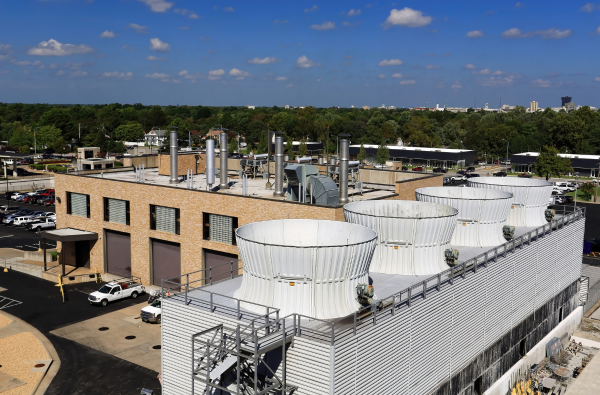
WUE is deliberately simple. It is the litres of water a facility consumes for every kilowatt-hour of IT energy it delivers — litres per kilowatt-hour (L/kWh). Lower is better. A site that leans on evaporative cooling reports a higher WUE than one running a closed loop, because evaporative towers do their job precisely by letting water evaporate.
The headline figure usually counts on-site water — the water drawn through the cooling system. A broader version, sometimes called source WUE, adds the water consumed off-site generating the electricity the facility uses. Both matter, but the one operators can directly influence is the on-site number, and that is where cooling-water management earns its place.
The key thing to hold onto: WUE is a ratio. You improve it either by lifting the denominator (more useful compute per unit of water) or by shrinking the numerator (less water consumed for the same cooling). The first is largely an IT and design decision. The second is a water-engineering decision — and it is the one most operators leave on the table.
Why the number is under scrutiny
For years, WUE was a footnote next to PUE, its energy-efficiency cousin. That has changed. Hyperscale and colocation growth has collided with drought, tightening trade-waste rules, and communities that — quite reasonably — ask how much of their water a new data centre will use. A credible WUE story is now part of the planning conversation, not an afterthought once the building is up.
Water has quietly moved from an operating detail to an approval-and-reputation issue.
That shift rewards operators who can show not just a target WUE, but a concrete plan for hitting it.
The lever most sites overlook
Here is the part that surprises people. The fastest route to a better on-site WUE is often not using less water at the tower — it is re-using the water you already have.
Cooling towers concentrate dissolved solids as they evaporate, and eventually that concentrated water has to be bled off as blowdown and replaced with fresh make-up water. That make-up draw is a big part of the numerator in your WUE. If you can treat tower water and return it to the loop instead of discharging it and topping up from mains, you cut make-up demand — and the ratio moves in your favour without touching the IT load.
The catch has always been that tower water is awkward to treat: variable chemistry, suspended solids, biological load. That is exactly the problem dynamic-membrane filtration was built for.
How dynamic-membrane recycling moves the number
The Purus platform is a dynamic pre-coat membrane system designed to recover difficult industrial water on site. Rather than relying on a fixed, factory-made membrane, it forms a fine separating layer in service and renews it through backwash — a regenerable gel layer that resists the fouling that defeats conventional membranes on messy feed.
A single vessel runs a configurable stack of five filter elements — 20, 10, 5 and 3 micron stages, down to an approximately 10 nanometre gel layer — so one architecture spans coarse clean-up through to fine polishing, including up to 6-log microbial reduction. It does this at low operating pressure with low chemical use, in a compact skid roughly 2 × 2 × 2 m, in models scaling from the 20.1 through the 50.2, 100.5 and 100.20. Performance is application-dependent and open to site-specific verification on request.
For a cooling loop, the relevance is direct: treating blowdown to a quality that lets it return to the tower shrinks make-up draw, which is the part of WUE you can actually act on. As a platform capability, dynamic-membrane recovery offers a confirmed pathway to 77%+ water recovery on suitable streams — a target Blue Quest is piloting on real cooling water at a major Brisbane data centre. That figure is a demonstrated platform capability, not a guaranteed cooling-water result for any given site. The honest way to land on your number is a short trial on your actual water, with results verified site-specifically on request.
What "better WUE" doesn't mean
A word of caution. A lower WUE is not automatically a lower environmental footprint — pushing water consumption down can, if you are not careful, push energy consumption up, and the reverse holds too. The two metrics are best read together. Recycling is attractive precisely because it improves the water side without leaning hard on the energy side: low-pressure membrane filtration is modest on power compared with the make-up water and discharge it displaces. But treat any single number — WUE included — as one input to a fuller picture, not the whole story.
What is a good WUE for a data centre?
There is no universal pass mark. WUE varies enormously with climate, cooling design and how the facility sources its power, so a sensible target for an evaporatively cooled site in a hot, dry region looks very different from a closed-loop facility in a cool one. What matters more than a single benchmark is a credible, evidenced plan for the number you commit to.
Does improving WUE make energy use worse?
It can, which is why the two are read together. Some water savings come at an energy cost, and the reverse holds too. Onsite recycling is attractive because low-pressure dynamic-membrane filtration improves the water side with modest energy demand, rather than trading one metric hard against the other.
How does recycling cooling water actually lower WUE?
Most on-site water consumption is make-up water replacing what evaporates and what is bled off as blowdown. Treating that blowdown so it can return to the loop cuts the make-up you draw, shrinking the numerator of the WUE ratio while the IT load — the denominator — stays the same.
Model your numbers.
See what a Purus configuration does for your throughput, water quality and OPEX — then talk it through with the engineering team. Performance figures are indicative; site-specific verification on request.